

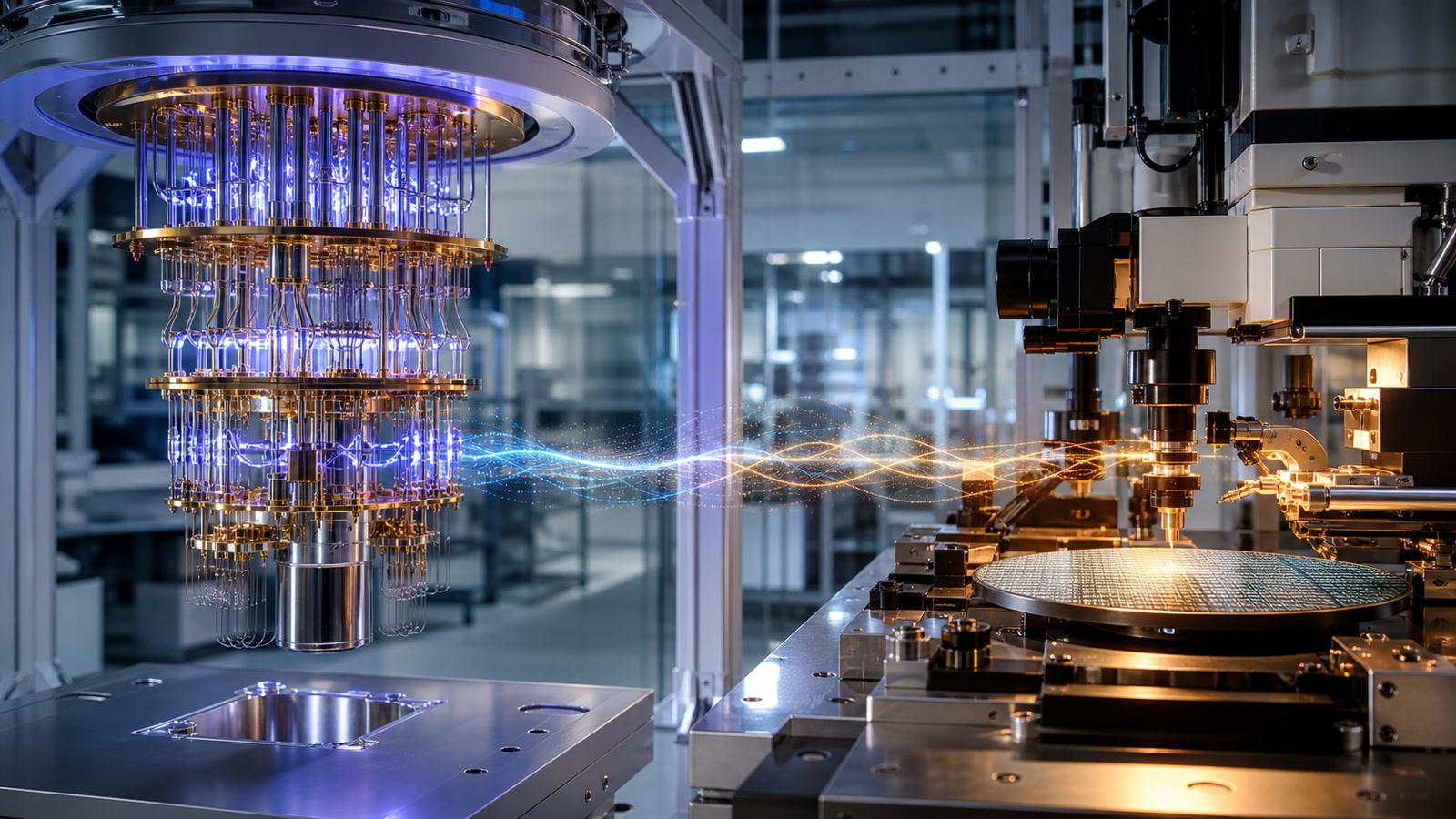
Quantum hardware • strategy, not hype
IBM has completed its acquisition of HRL Laboratories, adding a silicon-spin-qubit program alongside IBM’s superconducting-quantum work.[1] The practical story is not that one qubit has already defeated the other; it is that IBM is keeping two hardware paths available while the engineering tradeoffs remain unsettled.[2]
- IBM alone confirms that the transaction closed on August 26, 2026; Reuters reported the agreement and its rationale on July 23, before closing.[1][2]
- Financial terms were not disclosed.[1]
- The Quantum Insider separately reported the completion, but its detailed account follows IBM’s announcement; it is specialist context, not independent confirmation of the closing mechanics.[3]
What “two-track” means
Superconducting qubits
IBM says it is continuing its superconducting architecture through work on hardware, error correction, software, and algorithms.[1]
Silicon-spin qubits
HRL brings silicon-spin-qubit expertise plus work in sensing, materials, cryogenics, control electronics, packaging, and interconnects.[1][3]
Reuters reported that both approaches can use equipment employed in conventional chip fabrication, while electron-spin circuits can be made much smaller than superconducting circuits.[2] Reuters also quoted IBM Research director Jay Gambetta saying the future could be spins, superconducting systems, or a combination of the two.[2]
Why IBM may want both paths
Analysis A second architecture can spread technical risk: progress on one track does not require IBM to abandon learning on the other.[2] That is a strategy inference from the portfolio described by Reuters, not a measured performance result.[2]
Analysis The two tracks may also share useful manufacturing knowledge even if they do not converge into one processor.[1] IBM says HRL’s silicon-based expertise creates opportunities for future collaboration with Anderon, its quantum wafer foundry, across multiple computing modalities.[1] “Creates opportunities” is important wording: IBM has described a direction, not a completed production system.[1]
IBM says Boeing and General Motors, HRL’s former owners, will continue partnering with IBM and HRL on quantum applications and advanced technology development.[1] Reuters reported the same planned continuation when the deal was announced.[2]
Roadmap targets are not finished machines
IBM plan IBM’s current announcement says it expects its fault-tolerant Starling system by 2029, with a target of 100 million quantum operations, and targets Blue Jay for the mid-2030s.[1] Those are company roadmap targets, not systems demonstrated by this acquisition.[1]
The cited material does not provide an acquisition price, a post-acquisition silicon-spin product date, comparative error rates, or proof that the two architectures have been integrated into one working computer.[1][2][3]
Bottom line
The acquisition is evidence of a broader IBM hardware portfolio, not evidence that useful, large-scale quantum computing has suddenly arrived.[1][2] The near-term change is organizational and technical: IBM now owns HRL’s silicon-spin expertise while continuing its superconducting roadmap.[1] The longer-term outcome—spin, superconducting, or some combination—remains an engineering question rather than a settled victory lap.[2]
Sources and reporting notes
- IBM — “IBM Completes Acquisition of HRL Laboratories to Accelerate the Future of Quantum” (August 26, 2026; primary source and sole cited confirmation that the transaction closed)
- Reuters — “IBM buys HRL Laboratories in shift to two-track quantum computing strategy” (July 23, 2026; independent reporting on the agreement, technology comparison, and two-track rationale; not closing confirmation)
- The Quantum Insider — “IBM Completes Acquisition of HRL Laboratories” (August 26, 2026; specialist coverage substantially based on IBM’s announcement)
Reporting cutoff: August 28, 2026, 11:06 a.m. EDT / 15:06 UTC. This local editorial candidate uses no inline hero and makes no claim that an image exists.