

The Night Shift: Overnight Tech News with Jennifer Hudsen • 9:00 p.m. edition • Cutoff August 27, 2026, 9:00 p.m. EDT / August 28, 01:00 UTC
Anthropic Opens a Hardware Standard for AI-Controlled Labs—It Is a Limited Research Preview, Not Unsupervised Autonomy
Anthropic has opened a research preview of Model Hardware Standard, or MHS, a shared specification intended to let AI agents work with programmable laboratory and manufacturing devices. The preview begins with selected partners; Anthropic says it plans to develop safety evaluations and best practices before making the standard open source.[1] This article uses a disclosed near-window fallback: CNBC’s independent report was published at 18:00:13 UTC, about 4½ hours before the approximate 22:30 UTC core-window boundary, while its 19:08:46 UTC update remained inside the permitted six-hour fallback.[2]
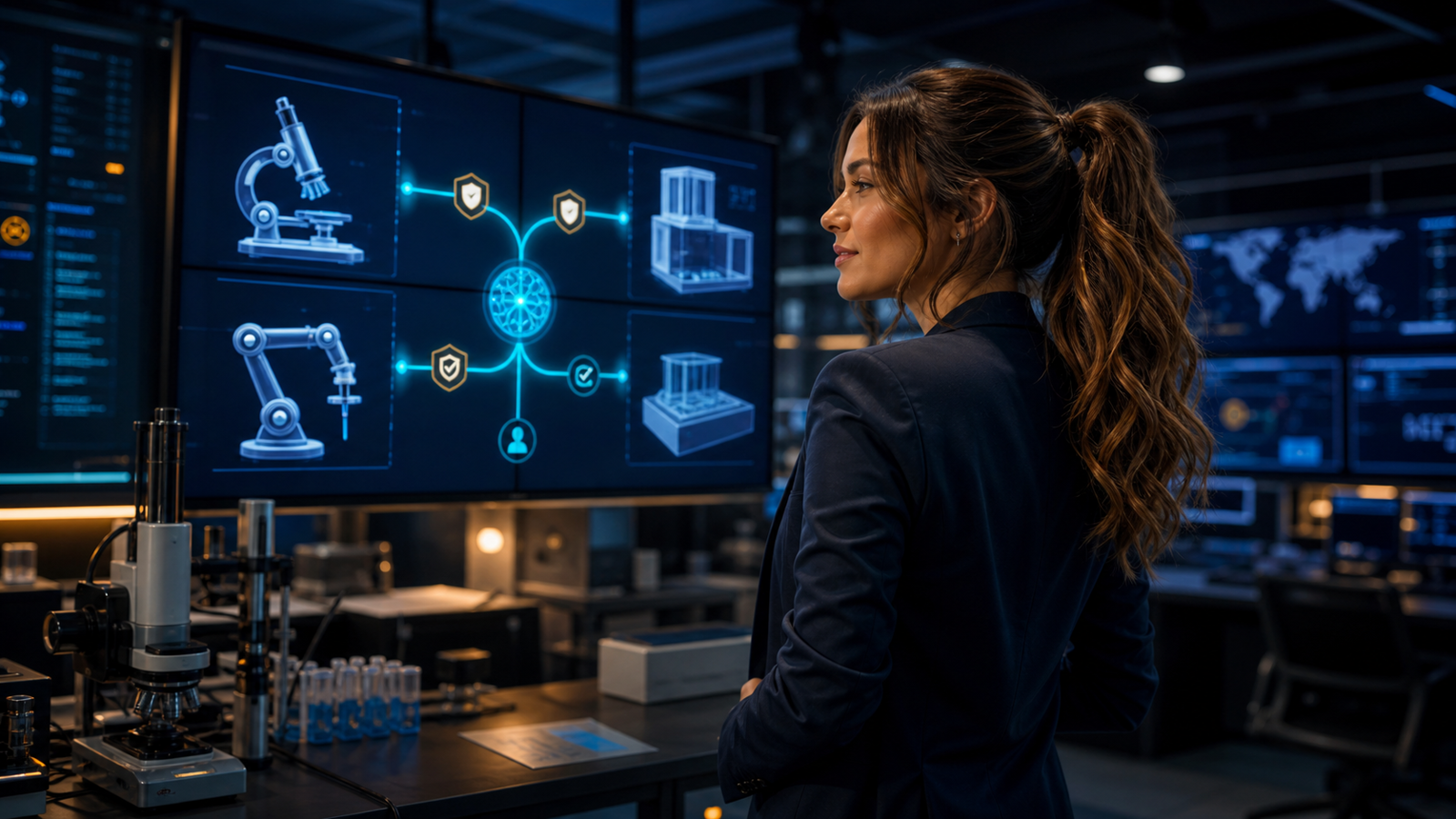
Featured-image disclosure: original Jennifer Hudsen newsroom concept art created for The IT Guys. It is not an Anthropic screenshot or a photograph of an MHS deployment; its generic lab equipment, connection map and safety icons are illustrative.
What happened
Anthropic announced “Previewing the Model Hardware Standard” on August 27. The company describes MHS as a common layer for devices such as microscopes, liquid handlers and robotic arms. Anthropic says the project began with the Howard Hughes Medical Institute’s Janelia Research Campus and is now being shared with an initial group spanning science, robotics, electronics and manufacturing.[1]
The basic design resembles a standardized driver system. An MHS driver exposes simple operations such as reading a temperature or writing a set point, describes the device in a discoverable format, and carries natural-language tags about characteristics and safety limits. Agents can reach connected equipment through Model Context Protocol, a command-line interface or code APIs.[1]
Anthropic says MHS is model-agnostic and can work with any device that has a programmable interface. That is an architectural goal and a company statement—not proof that every existing instrument is already compatible. Each device still needs a driver and an accurate description, and real facilities still have to validate their controls, interlocks, permissions and emergency procedures.[1]
The company reports demonstrations in which Claude adjusted a laser, observed the result through a camera, repeated the process and then wrote a deterministic alignment script. Anthropic also describes work at Janelia where shared device data helped guide neuroscience experiments. These are first-party observations from a controlled research program, not independent evidence that MHS can safely run arbitrary factories or laboratories without expert supervision.[1]
Why it matters
Most AI-agent stories still happen inside software: edit a document, call an API, query a database or run code. MHS aims at a more consequential boundary. Practical safety analysis: a mistaken database query can be serious; a mistaken command to a robot arm, heater, laser or chemical-handling system can create physical damage. Anthropic’s own preview emphasizes device characteristics and enforced safety limits, underscoring that physical control needs a stronger boundary than ordinary software output.[1] Standardizing access may make useful automation easier, but it also concentrates the need for trustworthy device descriptions, hard limits and accountability.
The integration problem is real. Labs and factories often accumulate instruments from different vendors, generations and software ecosystems. Anthropic says connecting a new device can take weeks or months and claims MHS can reduce some integration work to hours or minutes.[1] That speed claim comes from the developer and early collaborators. Buyers should test it against their own equipment, validation requirements and regulated procedures.
Analysis: the most useful idea is not “an AI runs the lab.” It is separating a common device vocabulary from the agent that makes decisions. If the interface is truly model-agnostic, organizations could test several agent systems against the same simulated hardware contract, keep deterministic operations outside online model reasoning, and replace the model without rewriting every device integration. The public announcement does not establish that this portability or switching path works across a broad vendor fleet.
Independent reporting reinforces the limited state. CNBC called MHS a research preview and reported that Anthropic intends to open-source it later; Reuters likewise described an early version shared with partners for safety work.[2][3][4] Those reports corroborate the announcement’s scope. They do not independently validate Anthropic’s timing, reliability or safety-performance claims.
Who is affected
Laboratory automation teams are the most immediate audience, particularly groups already writing custom adapters for microscopes, cameras, liquid handlers or motion-control systems. Advanced manufacturers may watch the standard for orchestration and error handling across programmable equipment. Hardware vendors could gain a common target for agent-readable drivers instead of maintaining a separate integration for every agent framework.
Security, safety and compliance teams should be involved from the beginning. A driver is not merely plumbing when it exposes a physical actuator. Device identity, command authorization, network segmentation, audit logs, safety-rated interlocks, rate limits, rollback behavior and manual stop paths belong in the design review—not as a cleanup after a pilot succeeds.
Ordinary consumers and small businesses do not have a product to install tonight. MHS is not a new Claude setting, a universal robot-control app or a generally available manufacturing service. Anthropic’s official page invites organizations to apply for preview access.[1]
What readers and technical teams should do
- Treat the preview as an experiment. Use simulated devices, digital twins or non-hazardous benches before connecting an agent to production equipment.
- Keep hard safety controls outside the model. Physical interlocks, travel limits, temperature ceilings, emergency stops and safety-rated logic should not depend on an AI instruction being interpreted correctly.
- Use least privilege. Give the agent only the commands, ranges, devices and time window required for one approved task. Separate read-only observation from write or motion authority.
- Validate the driver description. A precise API wrapped in inaccurate units, limits or coordinate systems is still unsafe. Test every range, sign, conversion and failure state against the manufacturer’s documentation.
- Record the chain of action. Preserve the human request, model decision, tool call, device response, safety check and final result. Logs should make it possible to reconstruct which layer initiated a physical change.
- Design for communications loss. Decide what the device does when the agent, network, shared-memory process or control computer disappears mid-operation. The safe state should be deterministic.
- Require human approval for consequential transitions. Starting motion, applying energy, dispensing material, changing a safety boundary or moving from test to production should remain explicit gates until evidence supports a narrower policy.
Upside, cautions and unknowns
Potential upside: a shared, model-neutral device interface could reduce repetitive integration work and make experimental automation more reusable. Researchers may be able to coordinate several instruments, adapt parameters as data arrives and hand stable sequences to deterministic scripts rather than keeping a language model in every control loop.
Caution: the phrase “safely operate physical devices” is Anthropic’s stated design purpose, not a certification. The opened sources do not publish a complete threat model, failure-rate dataset, independent safety assessment, supported-device catalog, production service-level commitment or regulatory approval.[1]
Unknown: the public material does not yet establish how driver packages will be signed and updated, how competing implementations will prove compatibility, who is liable for a bad device description, how hazardous commands are classified, or which portions of the preview will ultimately be open-sourced. It also does not prove that autonomous round-the-clock workflows can operate without expert supervision across changing real-world conditions.[1]
Evidence state at the cutoff
| Question | Supported now | Not established |
|---|---|---|
| Availability | An application-based research preview is open to an initial partner group.[1] | General availability, pricing or a production support commitment. |
| Compatibility | Anthropic says MHS is model-agnostic and targets programmable devices.[1] | Universal compatibility with existing instruments or validated portability across every agent harness. |
| Demonstrations | Anthropic describes laser-alignment and neuroscience workflows in the preview.[1] | Independent benchmark results or safe unattended operation in arbitrary labs and factories. |
| Open source | Anthropic says open source is planned after partner safety work.[1] | A released repository, final license or fixed release date. |
Frequently asked questions
Can Claude now control any robot or laboratory instrument?
No. Anthropic says MHS works with programmable devices, but a compatible driver, accurate description and approved setup are still required. The present release is a limited research preview.[1]
Is MHS only for Claude?
Anthropic says the specification is model-agnostic and can be reached through standard mechanisms including MCP, command-line tools and APIs.[1] Broad cross-model interoperability has not yet been independently demonstrated in the opened sources.
Is the standard open source today?
Not according to the announcement. Anthropic says it is sharing an early version with partners first and plans to make the standard open source after developing safety evaluations and best practices.[1]
Does a safety-limit tag replace emergency-stop hardware?
No. Practical guidance from The IT Guys is to keep physical interlocks and deterministic emergency stops outside an AI model. The announcement describes device-level limits, but it does not claim that natural-language metadata replaces safety-rated controls.
What should a cautious pilot measure?
Track setup time, command error rates, unit and coordinate mistakes, device-discovery failures, recovery from network loss, audit completeness and whether every hazardous action remains inside a deterministic limit. Compare those results with the existing manual or scripted workflow.
Sources
- Anthropic: “Previewing the Model Hardware Standard” — official announcement, displayed date August 27, 2026; accessed at the reporting cutoff.
- CNBC: “Anthropic pushes into physical world with new standard to help AI agents operate machines” — published August 27, 2026 at 18:00:13 UTC; updated 19:08:46 UTC.
- Reuters: “Anthropic unveils new framework allowing AI agents to operate physical devices” — canonical report; the canonical page returned HTTP 401 to automated retrieval.
- SRN News syndication of the Reuters report — accessible attributed copy used to verify the Reuters body, byline and editing credit.
Reporting cutoff: August 27, 2026, 9:00:23 p.m. EDT / August 28, 2026, 01:00:23 UTC. This disclosed near-window fallback was selected because no stronger distinct subject with a verified displayed publication time inside the strict approximately 150-minute core window survived reconciliation. The article covers one subject and was checked against The IT Guys’ prior 36 hours, all WordPress statuses, earlier Night Shift issues, the shared ledger and Jennifer’s KB.