

The Night Shift: Overnight Tech News with Jennifer Hudsen • 9:00 p.m. edition • Cutoff 9:00 p.m. EDT / 01:00 UTC
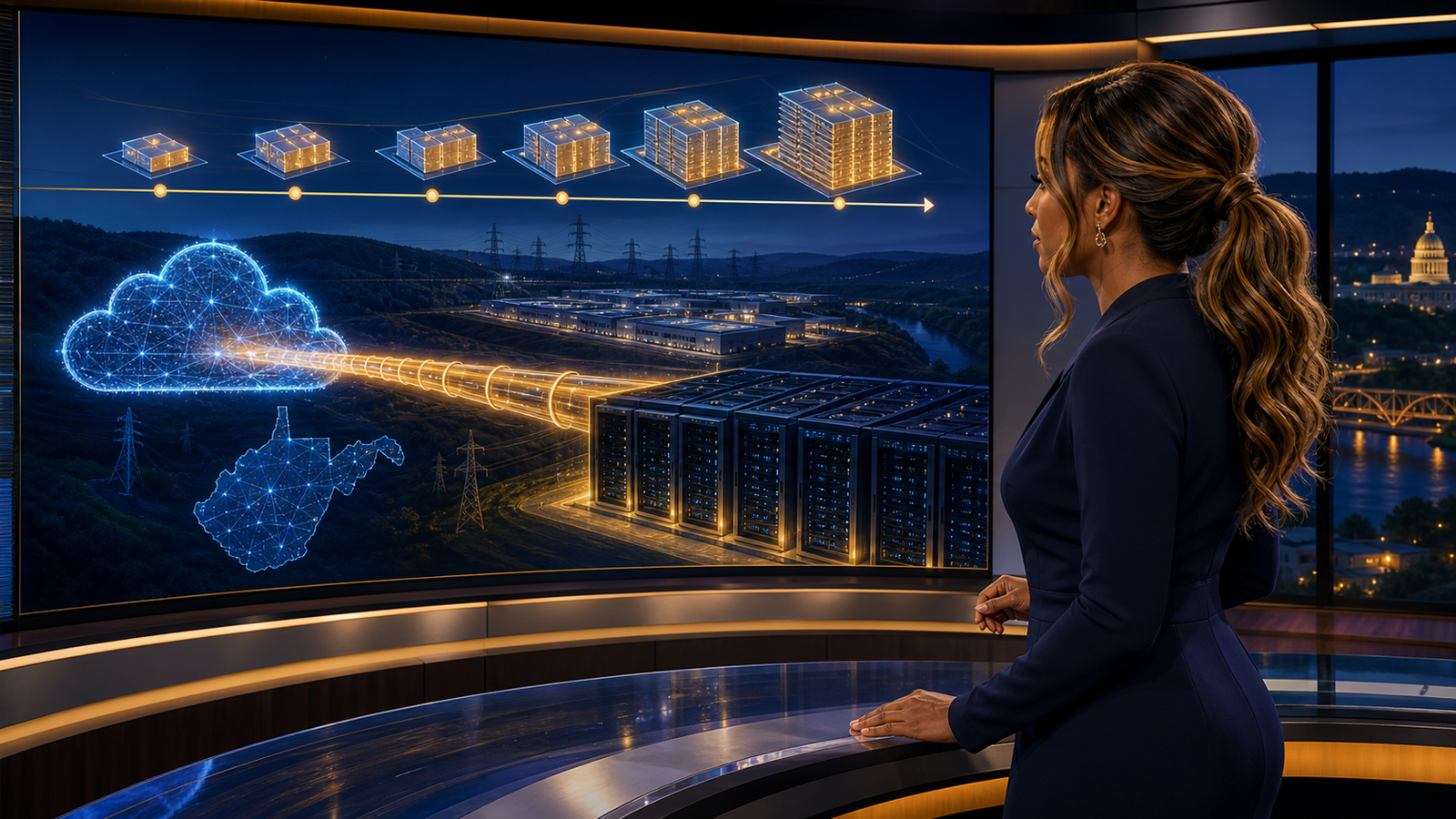
ORIGINAL EDITORIAL CONCEPT — NOT AN INCIDENT PHOTOGRAPH. Jennifer newsroom art created for The IT Guys. It visualizes a reported AI-compute lease and is not an official Anthropic or Nscale image, a real facility view, or evidence that the deal has been completed.
Report: Anthropic Will Rent $45 Billion of Nscale AI Compute—Neither Company Has Confirmed the Deal
Status: Reuters reports, citing one person familiar with the matter, that Anthropic will spend $45 billion over six years to rent about 460 megawatts of AI computing capacity from Nscale at a West Virginia campus. Anthropic declined to comment, and this newsroom found no matching deal announcement on the companies’ opened news pages at cutoff. [1] [2]
What happened
The report says Nscale would deploy NVIDIA’s next-generation Vera Rubin systems for Anthropic at a West Virginia data-center campus. The six-year rental is reported at $45 billion and roughly 460 megawatts. Those numbers come from an unnamed source, not a filed contract or joint company release. [1] [2]
Reuters’ accessible syndication copy was published at 1:21 p.m. Eastern time, about seven hours and 40 minutes before this desk cutoff and therefore outside the permitted six-hour fallback. It is background, not the timing qualifier. TechCrunch published separately sourced follow-on reporting at 5:37:39 p.m. Eastern—three hours, 23 minutes before cutoff—placing this subject inside the disclosed near-window fallback, not the strict 6:30–9:00 p.m. window. TechCrunch says a source familiar with the deal also described it to that outlet, but this newsroom cannot establish whether its unnamed source is independent from Reuters’ source. [2] [3]
Nscale has publicly announced an agreement to acquire American Intelligence & Power Corporation and the Monarch campus. Nscale said the site could span up to 2,250 acres, with initial power capacity of two gigawatts expected in the first half of 2028 and a longer-term path toward eight gigawatts by 2031. Those are Nscale’s acquisition and project plans, not proof that Anthropic has leased capacity there. [4]
Why it matters
If accurate, the commitment would show how frontier-AI competition is becoming a long-term infrastructure contest. Model companies need scarce accelerators, power, cooling, land, networking and construction schedules—not only better algorithms. A 460-megawatt lease would be large enough to affect regional planning and would lock Anthropic into a multi-year compute path, but the reported amount is a contract value, not money already spent or equipment already operating. [1]
The reported use of Vera Rubin matters because it ties the deal to systems that are not yet a mature installed fleet at the campus. Delivery, construction, utility interconnection and commissioning all stand between an agreement and usable model capacity. The opened reporting does not provide a rack count, energization schedule, service-level terms, cancellation provisions or a breakdown of power versus computing charges. [1] [2]
The headline price also needs a denominator. Spread evenly across six years, the reported total would average $7.5 billion per year, but real contracts rarely bill in a perfectly straight line. Without the agreement, readers cannot know how much is fixed, usage-based, contingent on delivery milestones or protected by termination rights. That arithmetic helps explain scale; it does not reveal the undisclosed payment schedule.
For ordinary Claude customers, there is no announced product change tonight. The report does not establish a new Claude model, lower subscription price, faster response time, local West Virginia availability, or a date when customers would benefit. Infrastructure may eventually ease capacity pressure, but that is analysis—not a promised outcome.
Who is affected
Anthropic customers and developers: the reported capacity could support future demand, especially for compute-heavy coding and agent workloads. Customers should not change budgets or architecture around it until Anthropic publishes availability and product documentation.
West Virginia communities and utilities: a campus of this scale can create construction and operations work while also raising practical questions about generation, transmission, water, noise, tax incentives and who carries infrastructure costs. The opened report supplies the lease size but not a public utility-impact study or community agreement. [1] [4]
NVIDIA and AI-infrastructure suppliers: a real Vera Rubin deployment of the reported scale would mean demand for racks, networking, cooling, electrical gear and site operations. The sources do not establish exact system counts or a completed NVIDIA order for this Anthropic workload. [1]
What readers should do
- Keep the word “reported” attached. Do not treat the $45 billion figure as a confirmed joint announcement, completed payment or operating facility.
- Separate contract value from capacity online. A six-year rental can be signed well before the power and computers are ready.
- Watch for primary records. The useful next evidence would be a joint release, financing disclosure, utility filing, equipment order, construction milestone or Anthropic statement.
- For business planning, use current Claude limits and prices. Do not assume future capacity changes today’s service levels.
- For local stakeholders, ask concrete questions. Timelines, grid upgrades, water use, emergency planning, incentives and consumer-rate protections matter more than the headline total.
Upside, cautions and unknowns
Upside: long-term capacity planning could reduce bottlenecks and support more reliable AI services if the project is financed, built and commissioned as reported.
Caution: the central terms are single-source reporting. Anthropic declined to comment, and company silence is not confirmation. Large infrastructure agreements can also change before hardware arrives. [1]
Unknown: neither the opened reporting nor Nscale’s campus announcement supplies a signed-contract document, exact rack count, payment schedule, utility source, customer launch date or proof that the reported 460 megawatts is currently energized. [1] [4]
Evidence table
| Claim | Evidence state | Boundary |
|---|---|---|
| $45 billion over six years | Reuters source report [1] | Not confirmed by a disclosed contract or joint release. |
| About 460 MW | Reuters source report [2] | Not proof that capacity is online. |
| Nscale’s announced Monarch campus plans | Nscale announced an acquisition agreement and project plans for Monarch [4] | The opened sources do not establish that Reuters’ reported Anthropic capacity is at Monarch. |
| Vera Rubin deployment | Reported by Reuters [1] | No exact system count or delivery schedule disclosed. |
Frequently asked questions
Did Anthropic announce a $45 billion deal?
No public Anthropic announcement was identified at cutoff. Reuters reported the agreement from one unnamed source, and Anthropic declined to comment. [1]
Is the data center running now?
The sources do not establish that the reported 460 megawatts is operating for Anthropic. Nscale’s March campus announcement described initial capacity expected in the first half of 2028. [4]
Will Claude get faster or cheaper?
No such customer outcome is announced. More compute may eventually help capacity, but performance and pricing depend on many technical and commercial choices.
Why publish an unconfirmed report?
The scale is materially important, Reuters directly attributes the information to a person familiar with the matter, and the site itself is supported by a primary Nscale announcement. The uncertainty is placed beside every consequential term rather than hidden at the bottom.
What would confirm the story?
A statement from Anthropic or Nscale, a disclosed agreement, financing or utility records, equipment orders, or construction milestones tied specifically to Anthropic would materially strengthen the evidence.
Sources
- Channel NewsAsia / Reuters — “Anthropic to rent AI computing power from Nscale for $45 billion, source says”, published August 27, 2026 at 1:21 a.m. Singapore time; updated 2:35 a.m.; checked at cutoff.
- WHTC / Reuters — “Anthropic to rent AI computing power from Nscale for $45 billion, source says”, published August 26, 2026 at 1:21 p.m. Eastern time; checked at cutoff.
- TechCrunch — “Anthropic continues compute-gobbling streak in $45B deal with Nscale”, published August 26, 2026 at 5:37:39 p.m. Eastern time; disclosed near-window qualifier checked at cutoff.
- Nscale — “Nscale Acquires American Intelligence & Power Corporation, Creating a Full Stack AI Hyperscaler, Integrated from Energy to Compute”, March 16, 2026; primary campus background checked at cutoff.
Reporting cutoff: August 26, 2026 at 9:00 p.m. EDT / August 27 at 01:00 UTC. TechCrunch’s separately sourced follow-on report is the disclosed near-window qualifier at three hours and 23 minutes before cutoff; the earlier Reuters report is background outside the six-hour fallback. This one subject was checked against all WordPress statuses, the prior 36 hours, earlier Night Shift output, the shared ledger and Jennifer’s knowledge base.