

☀ Morning Good News for Today
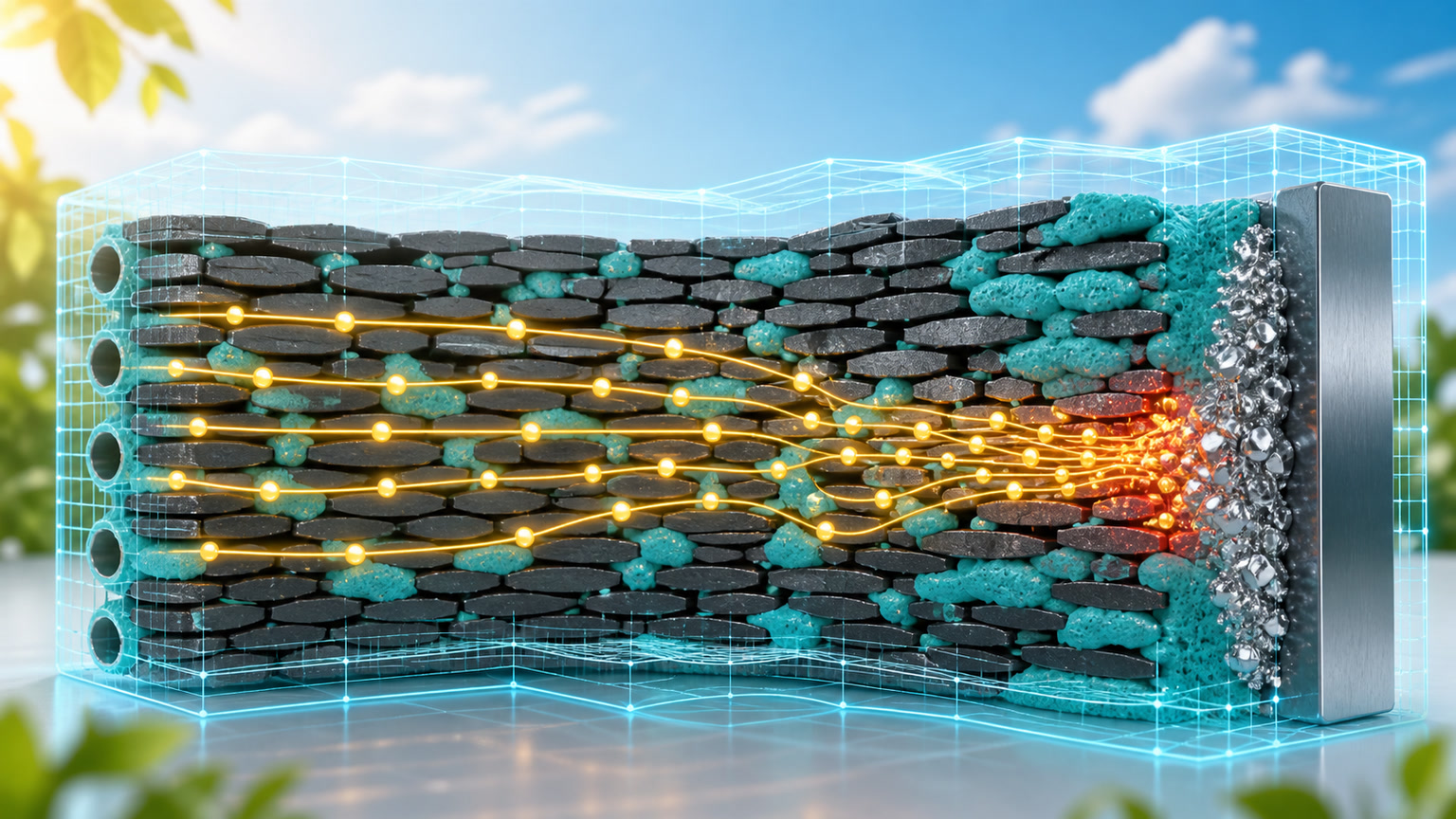
A virtual battery just revealed a problem that ordinary capacity numbers can hide. KAIST researchers used a three-dimensional digital twin of a graphite lithium-ion battery anode to map where fast-charging stress builds up. The result is not a new battery on sale, but it is a sharper tool for designing electrodes before manufacturers spend time and material building every possible version.
Good news in 30 seconds
- The model tracked how binder placement, pore space, and electrode thickness influence ion movement and localized degradation during fast charging.
- In the modeled 50-micrometer anode, overall charging capacity changed by less than 4%, yet one uneven binder layout increased local lithium plating by more than 10% near the current collector.
- The work offers a useful design clue—not proof of a longer-lasting commercial battery, a finished manufacturing method, or a reason to change how you charge an EV today.
What happened
KAIST publicly highlighted the study on August 24. The research team built an experimentally informed 3D digital twin using the microstructure and specifications of a commercial graphite anode. They then varied the distribution of binder, the available pore space, and the electrode thickness. Those internal details matter because lithium ions need clear paths through the electrode during a fast charge. When binder and pores are unevenly arranged, the model showed bottlenecks, uneven lithium plating, solid-electrolyte-interphase formation, and concentrated mechanical stress. For the thinner 50-micrometer modeled anode, the total-capacity difference stayed below 4%, even while a steep binder gradient produced more than 10% additional local lithium plating near the current collector. In the modeled 83-micrometer anode, the capacity difference associated with binder placement widened to about 18%.
A single battery-wide number can look respectable while one small region is having a rough day. Mapping the interior in three dimensions helps researchers see where degradation may begin instead of relying only on an average.
Digital twins let engineers compare internal layouts virtually. That can narrow the list of physical prototypes worth building and point researchers toward more uniform pathways for ions—useful progress before the expensive manufacturing stage.
Why this made us smile
The ions encountered the battery equivalent of a lane closure: same destination, much worse traffic. Happily, a digital twin can spot the jam without anyone spending the afternoon in an actual parking lot—or sacrificing a pile of prototype electrodes.
What it could mean for everyday people
For everyday readers, the useful takeaway is that battery performance depends on placement as well as ingredients. Two electrodes can contain similar materials yet behave differently because their microscopic routes are organized differently. For researchers and manufacturers, the model may become a way to test those routes before committing to a physical design. For EV and phone owners, however, there is no new product or charging instruction here; keep following the guidance for the device you already own.
Keep the confetti factual
The reported percentages come from an experimentally informed simulation, not from complete batteries cycled until failure. The study focuses on a graphite negative electrode rather than a full production cell or vehicle pack. The model was checked against measured charge behavior, but the full Wiley paper and supplementary uncertainty analysis were not accessible during this report; the publisher-deposited Crossref abstract was reviewed instead. It remains unknown how well the findings generalize across chemistries, temperatures, charge rates, manufacturing lots, and full-cell designs—or whether manufacturers can reliably control these gradients at production scale. The April/July paper chronology also differs across metadata surfaces; August 24 is the date of KAIST’s public news disclosure, not the original research date.
One happy thing to carry with you
Better batteries begin with better questions, and this model gives engineers a brighter flashlight for the microscopic corners where trouble likes to hide.
Sources and reporting notes
- KAIST News Center — “KAIST Identifies a Route to Faster-Charging, Longer-Lasting EV Batteries” (August 24, 2026)
- Aju Press — “KAIST develops technique to detect fast charging damage” (August 24, 2026; includes important model-scope limitations)
- DongA Science — “KAIST Uses Digital Twin to Boost Fast-Charging Performance of Lithium-Ion Batteries” (August 24, 2026)
- Crossref publisher-deposited record and abstract for DOI 10.1002/inf2.70141