

Nightly privacy and security casebook · August 22, 2026
The Hacker Diaries — Featuring Jennifer Hudsen: Case File No. 006
The night’s only qualifying Hacker News file was not a breach bulletin or a zero-day. It was a $400 million child-privacy settlement announcement whose fine print matters more than the round number: $300 million is described as immediate, another $100 million depends on a court order vacating a 2019 decree, the government says the resolved claims remain allegations, and the public docket shows corrective filings that make “case closed” too neat for the evidence.

The case board
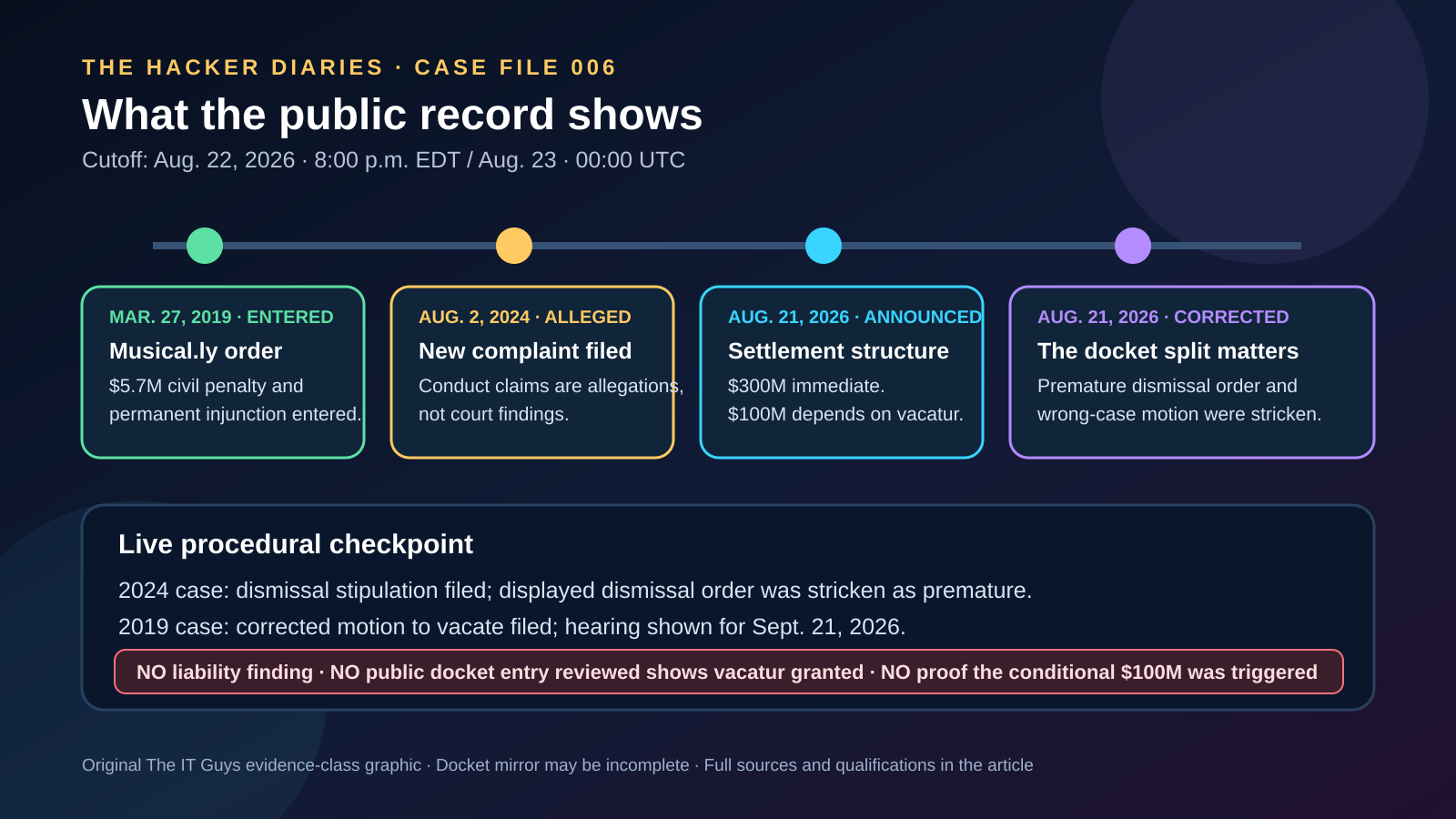
At first glance, the board says “$400 million settlement.” A disciplined read adds four tabs. First, the Justice Department announced the resolution; the accessible government page does not link a settlement instrument. Second, DOJ says the claims are allegations only and there has been no determination of liability. Third, the payment is split: $300 million now, $100 million only after a specified vacatur order. Fourth, the court record shows that a dismissal order in the 2024 case was issued prematurely and stricken, while a vacatur motion filed in that case was also stricken because it belonged in the older 2019 case. A corrected vacatur motion then appeared in the 2019 docket with a September 21 hearing date.
That does not erase the settlement. It does mean the honest status is a sequence, not a slogan: settlement announced; dismissal stipulated; premature order stricken; corrected vacatur motion pending in the displayed public record. The public mirror warns that its docket may be incomplete, so this is a reporting cutoff—not a claim that no later filing can exist.
Tonight’s risk at a glance
Phone readers: swipe the table left to see every column.
| Reader | Current risk | What the record supports | First sensible move |
|---|---|---|---|
| Parents and guardians | Privacy controls, age accuracy, unwanted contact and deletion follow-through | No evidence that every child account is compromised; historical allegations and a settlement are not an account-level diagnosis | Review the real account age, Family Pairing, visibility, messages and phone permissions together |
| Small businesses | Staff social-media use, brand accounts, minors in marketing and unnecessary access | No broad business-system exposure from this settlement announcement | Inventory who owns accounts, reduce shared credentials and document a privacy/escalation route |
| Administrators | Evidence preservation, managed-device permissions and support boundaries | The case concerns alleged platform practices, not a patchable CVE or local-network exploit | Do not scan or seize family content; preserve only what is needed, then apply documented controls |
| Developers and product owners | Age assurance, parental consent, deletion workflows and retention design | The complaint is a warning about control design and recordkeeping; its allegations are not a reusable technical specification | Map each data flow, consent event, deletion path, retention location and audit record |
| Enterprise/legal teams | Policy claims outrunning operational proof | DOJ credits compliance improvements but does not publish an independent technical audit | Test controls and deletion evidence instead of relying only on policy language |
Subject 1Privacy and regulationNo liability finding
The headline wore a fedora; the docket carried the receipts
What happened
On August 21, the U.S. Department of Justice announced a $400 million settlement with TikTok, ByteDance and affiliated entities intended to resolve federal litigation over alleged violations of the Children’s Online Privacy Protection Act and its implementing rule. DOJ described the recovery as one of the largest ever obtained in a COPPA case. That description is narrower than “the largest privacy settlement ever,” and the release does not announce direct payments to parents or children.
The announced payment structure is asymmetric. DOJ says $300 million is payable immediately. The remaining $100 million becomes payable “upon entry of an order” vacating a prior consent decree against Musical.ly, TikTok’s predecessor. The difference between a signed deal, a filed motion and an entered order is not legal trivia here; it is the switch attached to one-quarter of the announced total.
DOJ also supplies the most important liability boundary: the claims resolved by the United States are allegations only, and there has been no determination of liability. TechCrunch separately reported that the agreement does not require TikTok or ByteDance to admit wrongdoing. Accurate coverage therefore says the government alleged the conduct and the parties reached a settlement. It does not say a court proved every allegation, convicted anyone or entered a $400 million guilt judgment.
Verified evidence and timeline
- February–March 2019: the United States sued Musical.ly, and the court entered a stipulated order on March 27. The order included a $5.7 million civil penalty and a permanent injunction with COPPA-related obligations.
- August 2, 2024: DOJ, acting on an FTC referral, filed United States v. ByteDance Ltd. et al., case 2:24-cv-06535, in the Central District of California. The complaint sought an injunction, civil penalties and other relief.
- August 21, 2026: DOJ announced the $400 million settlement structure. The 2024 docket shows a stipulation to dismiss filed as entry 83.
- Corrective sequence: entry 84 was a motion to vacate the 2019 order but was filed in the 2024 case; the court’s deficiency notice said it was submitted in the wrong case, and entry 88 says it was stricken. Entry 85 was an order dismissing the 2024 action with prejudice, but entry 87 says that order was issued prematurely and was stricken.
- Correct case: the 2019 Musical.ly docket shows a corrected motion to vacate as entry 12, with a hearing displayed for September 21, 2026 at 1:30 p.m. The latest public entry reviewed is a motion—not an order granting it.
This chronology supports a careful conclusion: the settlement is real as an announced agreement, but the public docket mirror did not yet show the specified vacatur order entered at the cutoff. Therefore this article does not say the contingent $100 million has been triggered. It also does not try to decide the full legal effect of the parties’ dismissal stipulation; that is a legal question beyond what the public mirror alone establishes.
Who and what is exposed
This is not a vulnerability advisory. There is no affected-version table, CVE, patch package or network indicator. The legal case concerns alleged practices involving children under 13, account creation, parental notice and consent, age controls, data collection, deletion requests, retention and compliance records.
The 2024 complaint alleged that children could reach the general TikTok experience, that certain third-party sign-in paths previously bypassed the age gate, and that Kids Mode collected information beyond what the government said COPPA allowed. It alleged that some parental deletion requests were difficult to submit or were not honored, and that information could remain in multiple database locations after an account was marked for deletion. These are allegations in a complaint, not current findings about every account or a guarantee that the same product behavior exists today.
Two numbers need their denominators. The complaint says that between February 2019 and July 2022, more than 300,000 Kids Mode problem reports included children’s email addresses. That does not necessarily mean 300,000 unique children. It also describes a sample of roughly 1,700 accounts associated with complaints and deletion requests: about 500 remained active as of November 1, 2021, which is approximately 29.4%, matching the complaint’s rounded 30% description; several hundred were still active in March 2023. Those are historical sample observations alleged by the government—not a current failure rate for all accounts.
What was observed in the wild
“In the wild” is a security phrase that can mislead here. The complaint describes alleged real-world platform operations, internal processes, parental requests and account samples. It is not a malware report, and the sources do not establish an attacker campaign, stolen credentials, an exploitable endpoint or named Treasure Coast victims.
No local incident is claimed in Port Saint Lucie, Jensen Beach, Fort Pierce or Vero Beach. A family in those communities should not infer that a child’s account was breached merely because DOJ announced a settlement. The practical reason to review an account is ordinary privacy hygiene: confirm the age is accurate, limit unnecessary permissions and interactions, and make sure reporting or deletion requests produce trackable confirmations.
What succeeded, failed or remains unknown
What the government says improved: DOJ says TikTok underwent significant changes in ownership, management, compliance functions and privacy practices after the 2024 complaint. It credits measures designed to improve younger-user safeguards, age-related controls and parental oversight. That is the government’s explanation for the resolution; it is not a published independent technical audit of every control.
What the complaint said failed historically: the government alleged inadequate age screening, deletion handling, retention practices, moderation escalations and compliance recordkeeping. Some complaint details are sharply bounded in time; treating them as a description of the current platform would erase the dates and the settlement’s own acknowledgment of changes.
What remains unknown: the DOJ page does not link the settlement agreement or a stipulated order. It notes that the release was updated but supplies no public change log. The public docket mirror says it may be incomplete. TikTok’s rendered U.S. newsroom did not show a settlement statement at the cutoff, and AP reported that company representatives did not immediately respond to a request for comment Friday. None of that proves a statement does not exist somewhere else.
Why it matters to homes and small businesses
For families, this case is a reminder that “private account” is not the same thing as “minimal data.” A platform can still receive device identifiers, activity, account information and content. Parents should focus on the controls they can verify without secretly taking over a teen’s digital life: accurate age, account discoverability, who can message or comment, content reuse, Family Pairing and phone-level permissions.
For small businesses, the lesson is governance. A shop that lets several employees share one social-media login has the same fundamental problem as a family that cannot identify which account or device is involved: no clean ownership trail. Businesses should use unique managed access where the platform supports it, keep recovery information current, document who can publish or answer messages, and have a route for privacy or safety complaints. If minors appear in business content, obtain appropriate consent and minimize identifying information; this article is not legal advice, so businesses with regulated or high-risk programs should involve counsel.
For developers, the deeper lesson is deletion architecture. A “delete” button is not an outcome unless the service knows every store, derivative and processor that must change. Good engineering maps collection purpose, consent, retention, copies, backups, analytics, model inputs, third-party transfers, audit records and exception handling. A support queue should prove that requests were received, scoped, completed and checked—not merely that a front-end account vanished.
Immediate actions
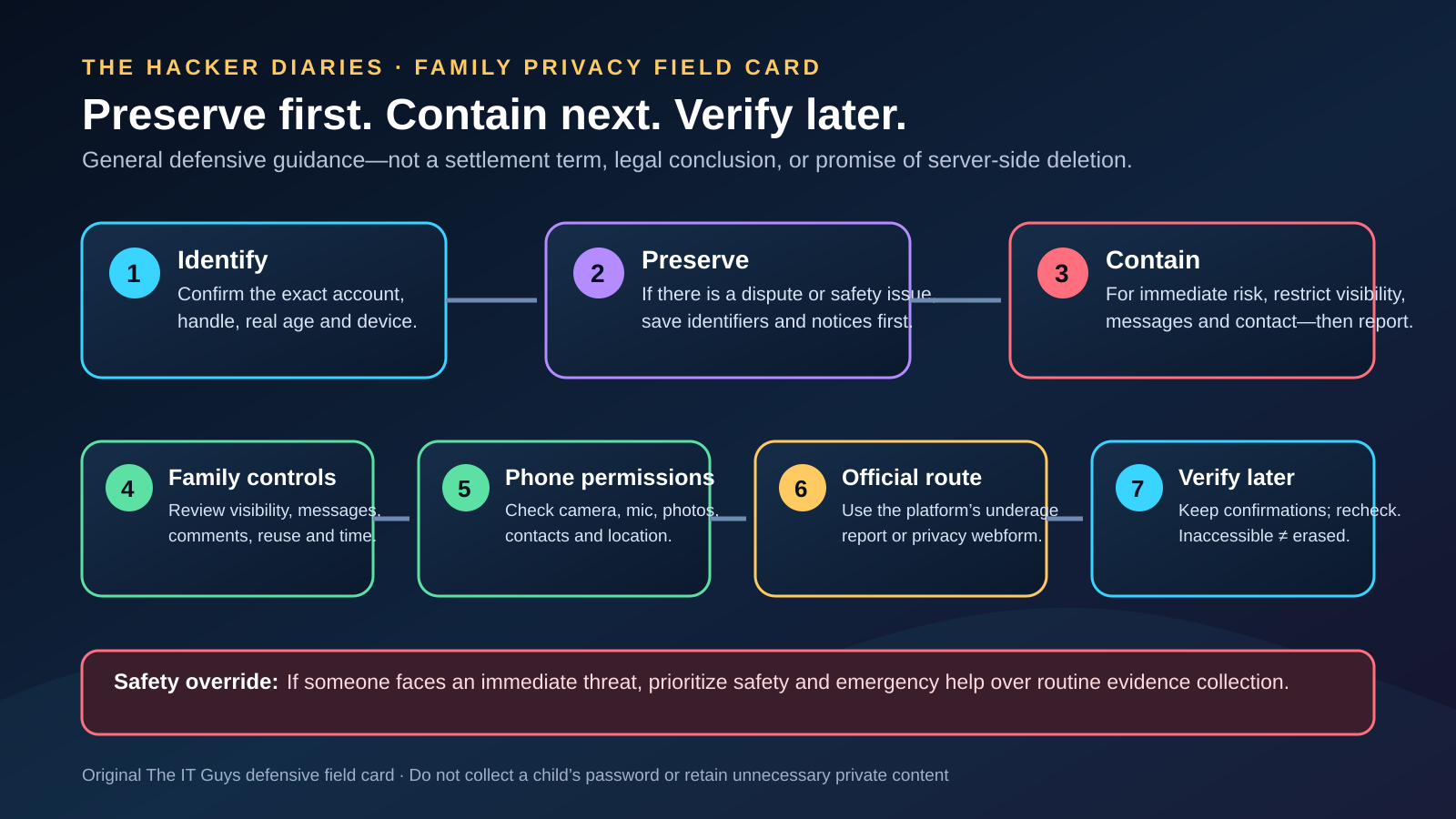
- Confirm the exact account and real age. Do not coach a child to enter a false birthday to unlock features. Record the account handle and device before changing anything if a support or safety issue is already underway.
- Preserve only what is necessary. Save confirmation emails, report numbers, relevant URLs and a small number of screenshots when there is a dispute or safety concern. Do not collect a child’s password, download private message histories without a legitimate need, or retain unrelated personal content.
- Contain immediate contact risk. If unwanted contact or exposure is active, restrict discoverability, direct messages, comments and content reuse; block and report as appropriate. Immediate safety takes priority over routine evidence collection.
- Review Family Pairing together. TikTok’s current support page lists controls for screen time, time away, notifications, search, discoverability, direct messages, comments, blocked accounts and content reuse. Availability can vary by age and region.
- Check the phone, not only the app. Review camera, microphone, photos, contacts, location and notification permissions on Android or iPhone. Disable access that is not needed.
- Use the official route. TikTok publishes in-app, browser and webform paths for reporting an underage account. Its support page directs U.S. parents seeking deletion of an under-13 account to a privacy webform.
- Keep the receipt and verify later. Account inaccessibility does not prove every server-side copy was erased. Keep confirmations, revisit the account, and follow up through the privacy channel if the result is unclear.
Detection and verification
For a family review, “detection” means finding mismatches: the birthday does not reflect the user’s age; a supposedly private account is discoverable; direct messages or comments are more open than expected; a teen can reduce restrictions that a parent believed were locked; old devices remain signed in; or the phone grants permissions the family did not intend.
For business accounts, verify the owner email, recovery methods, active sessions, connected apps, publishing permissions and escalation contact. Capture the before-and-after settings without storing private message content. If a vendor says a deletion request is complete, retain the confirmation and verify the visible account state later. Do not promise a customer that a disabled login proves backend erasure.
Recovery and escalation
If an account is merely misconfigured, document the old setting, apply the narrow correction and verify it from a second logged-out or family-linked view. If the account is compromised, use a clean device to reset the password, revoke sessions, remove unknown connected apps, secure the recovery email and enable stronger multifactor protection where available. Preserve suspicious notifications before deleting them.
If there is an immediate threat, stalking, coercion or a child-safety emergency, prioritize physical safety and appropriate emergency or law-enforcement help. Do not confront a suspected offender through the child’s account, circulate harmful material, or turn a family review into amateur forensics. The IT Guys can help with device settings, account recovery and documentation in local at-home support; businesses can use the small-business service path. Neither service replaces legal counsel or emergency response.
Good news
The announced recovery is substantial, DOJ publicly acknowledges compliance changes, and families have practical controls they can review tonight without waiting for litigation to finish. The docket also demonstrates a healthy corrective mechanism: an order entered prematurely and a motion filed in the wrong case were not silently treated as clean finality; corrective entries identified and struck them.
Bad news
The historical allegations describe the exact kind of privacy failure that is hard for a parent to see: collection, retention, deletion and internal routing happen behind the interface. The settlement instrument is not linked from the public DOJ page, the release’s update lacks a change log, and the public docket mirror is incomplete. Those gaps prevent confident claims about every obligation, the final procedural state or when the conditional payment becomes due.
Confidence and uncertainty
High confidence: DOJ’s announcement, the $300 million/$100 million split, the no-liability disclaimer, the 2019 order, the 2024 complaint identity and the displayed corrective docket entries.
Moderate confidence: the public docket’s current completeness. Two case histories agree on the wrong-case/correct-case sequence, but the mirror itself warns it may omit material. The chronology is frozen to the stated cutoff.
Attributed, not independently audited: DOJ’s description of TikTok’s compliance improvements and the complaint’s allegations about internal practices. Unknown: the complete settlement obligations, whether TikTok later issued a statement outside the rendered U.S. newsroom, and the eventual outcome of the vacatur motion.
Direct sources
- DOJ: Justice Department Secures $400M Settlement with TikTok and ByteDance to Resolve Children’s Privacy Litigation
- DOJ-hosted 2024 complaint, United States v. ByteDance Ltd. et al.
- Public docket mirror: 2024 case
- Public docket mirror: 2019 Musical.ly case
- Associated Press: TikTok reaches $400 million settlement with US Justice Department over children’s privacy
Do this tonight / this week
Do this tonight
- Confirm the account age, visibility and active device.
- Review direct messages, comments, discoverability and reuse settings.
- Check camera, microphone, photos, contacts and location permissions.
- Link or review Family Pairing where appropriate.
- Save report/deletion confirmations; do not save unrelated private content.
- Treat any “settlement registration” request for money or banking details as suspicious—the DOJ release announces no family refund program.
Do this week
- Review every device where the account is signed in and retire old sessions.
- Document who owns family or business recovery email and phone numbers.
- For a deletion request, verify the visible result and retain the confirmation.
- For business accounts, replace shared passwords with managed access where supported.
- Schedule a quarterly privacy review after major app or phone updates.
- If a safety incident exists, escalate to qualified help rather than collecting more sensitive content.
FAQ from the night desk
Did a court find TikTok liable for the 2024 allegations?
No. DOJ says the resolved claims are allegations only and there has been no determination of liability.
Did TikTok already pay a $400 million fine?
That wording is too strong. DOJ announced a settlement in which $300 million is payable immediately and $100 million depends on entry of an order vacating the 2019 decree. The public docket mirror did not show that order granted at the cutoff.
Was the 2024 case dismissed?
The docket shows a stipulation to dismiss. It also shows that a dismissal order was issued prematurely and stricken. This article does not substitute a public mirror for legal advice about the stipulation’s full effect; it reports the sequence and avoids calling the stricken order operative.
Why was a vacatur motion stricken?
The deficiency notice says the motion was filed in the wrong case. The 2024-case copy was stricken, and a corrected motion appears in the 2019 Musical.ly case with a September 21 hearing date.
Will parents or children receive settlement checks?
The DOJ release does not announce a family refund program. Do not provide bank information or pay a fee to anyone claiming they can register you for one.
Does this prove my child’s account was compromised?
No. The case concerns alleged privacy practices, not an account-specific breach. Review the account because good privacy hygiene is useful, not because this headline proves a local compromise.
Does deleting the account erase every copy of its data?
An inaccessible account does not independently prove complete server-side erasure. Use the official privacy route, keep the confirmation and follow up if the result is unclear.
Where can I read the shorter family-focused guide?
The IT Guys published an earlier same-day guide: DOJ Announces TikTok’s $400 Million Child-Privacy Settlement: What Was Alleged—and What Parents Should Check. This casebook adds the two-case corrective docket sequence and a deeper operational playbook.
Methodology and source note
The Hacker News homepage was rendered and enumerated at the start of the run and rescanned immediately before the candidate ledger was frozen. One genuine editorial item displayed August 22, 2026. Its article was read for subject discovery, but its prose, structure and compilation order were not reused. The subject was rebuilt from the DOJ announcement, the DOJ-hosted 2024 complaint, the 2019 and 2024 docket histories, AP, TechCrunch and current TikTok support pages.
Every number and procedural verb is state-labeled. Filed is not entered; announced is not adjudicated; stricken is not operative; a motion is not an order; an allegation is not a finding. The public docket mirror may be incomplete, so load-bearing sources were scheduled for another live recheck immediately before publication.
For continuity, the earlier 5 PM Technology News Recap covered the breaking announcement. This edition is deliberately deeper and does not claim a Treasure Coast incident.
Full direct source list
- The Hacker News candidate article — discovery/context only.
- DOJ settlement announcement.
- DOJ’s archived 2024 case announcement.
- 2024 complaint PDF.
- 2024 case public docket mirror.
- 2019 Musical.ly case public docket mirror.
- Associated Press report.
- TechCrunch report.
- TikTok Family Pairing help page.
- TikTok underage-account reporting page.
- TikTok U.S. Newsroom.
- FTC COPPA rule page.