

☀ Morning Good News for Today
NASA documented a modernized version of its long-used Chemical Equilibrium with Applications rocket-chemistry code — and quietly opened it up to modern engineering tools. It is the kind of “old-but-still-useful scientific software learns new APIs” story that does not need a press conference to count as a genuine piece of public infrastructure progress.
Good news in 30 seconds
- NASA’s August 21 technical bulletin, TB 26-04, documents CEA v3 — a modernization of the 2002-era Chemical Equilibrium with Applications code into a Fortran 2008, object-oriented package.
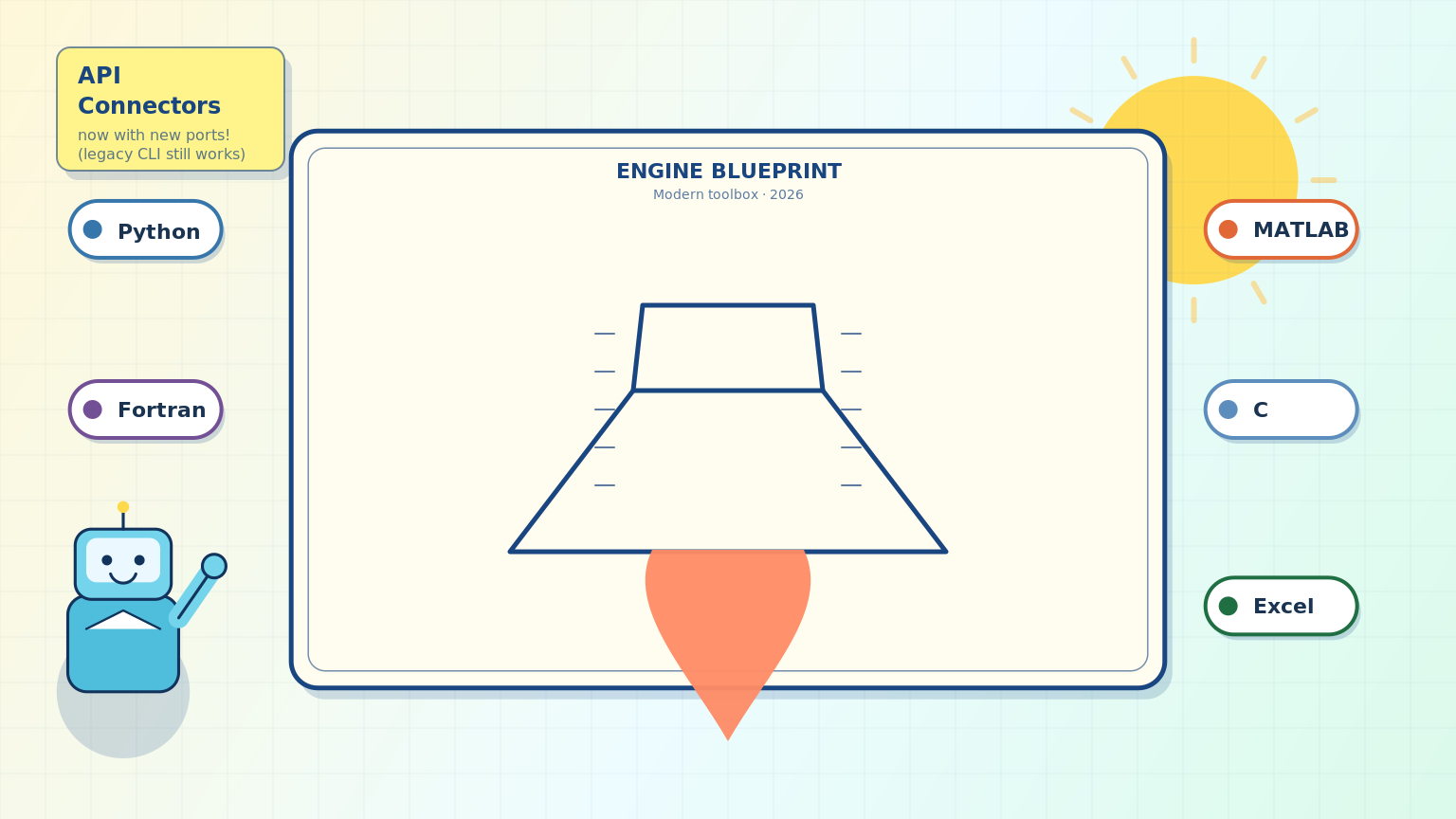
- CEA v3 now offers Fortran, C, Python, MATLAB, and Excel interfaces, while keeping the classic command-line path so older input files still work.
- NASA reports its thermodynamic database was expanded for green-propellant constituents (ADN, HAN, LMP-103S) and sustainable-aviation-fuel candidates (n-Butanol).
What happened
NASA’s Engineering and Safety Center published TB 26-04 on August 21, 2026, describing how NESC Activity TI-22-01730 modernized the agency’s long-running Chemical Equilibrium with Applications (CEA) code. CEA has been a foundational tool for propulsion and thermochemistry analysis since 2002, used across NASA and the wider aerospace community for equilibrium chemistry, rocket performance, shock, and detonation calculations. The original procedural Fortran implementation became increasingly hard to maintain and to plug into modern engineering workflows, and that drove the modernization effort.
CEA v3 is implemented in Fortran 2008 with object-oriented data structures, stricter typing, and a thread-safe equilibrium solver. It exposes the same engine to Fortran, C, Python, MATLAB, and Excel, and adds a subroutine interface for direct, high-volume calculations. A legacy command-line path is preserved so existing CEA input files can keep running with minimal disruption.
Modernizing an established scientific workhorse — instead of replacing it — is how public engineering tools stay useful. New interfaces let teams run automated parametric sweeps, optimization studies, and iterative design analyses without rewriting the chemistry.
The expanded thermodynamic database now covers green-propellant constituents (ADN, HAN, LMP-103S) and sustainable-aviation-fuel candidates such as n-Butanol, which means researchers studying cleaner propulsion and aviation fuels can keep using the same validated code instead of waiting for a brand-new tool to appear.
Why this made us smile
Twenty-four years is a long time to stay useful in the fast-moving world of scientific software. CEA v3 is essentially that veteran Fortran rocket-chemistry workhorse showing up to work one Monday with a fresh set of Python, MATLAB, C, and Excel adapters — and politely reminding everyone the classic command-line interface still works, thank you very much. We are officially at the “API connectors are the new power tools” stage of scientific computing, and we are mostly here for it.
What it could mean for everyday people
Everyday readers do not need to install CEA or buy anything. The useful takeaway is more general: when a public engineering tool gains modern interfaces without losing its old ones, the people who design rockets, study cleaner propellants, and explore future aviation fuels can do their jobs faster and more reliably. Those gains eventually reach the propulsion and aviation work that touches the broader economy, even when they happen quietly inside an engineering bulletin.
Keep the confetti factual
This article is built on NASA’s own TB 26-04 technical bulletin and the public CEA documentation and repository pages — there is no editorially independent benchmark reproduction to point to at this time. The headline speed comparison is NASA’s, attributed to NASA: in one benchmark a 108,500-case sweep finished in roughly 1.11 seconds in CEA v3 versus about 15 minutes in CEA2, while a single equilibrium calculation is roughly 40 percent slower in v3 (only about 0.004 seconds slower in absolute terms). NASA also explicitly recommends engineering review and validation when moving established or mission-critical workflows from CEA2 to v3. Independent adoption, broader benchmark reproduction, and the full hardware and compiler environment behind the cited number are not established here.
One happy thing to carry with you
An old, widely-used piece of public scientific software just got easier to teach new tricks — and kept its old ones. That is a quiet, useful kind of progress, and it is the kind worth noticing.
Sources and reporting notes
- NASA Engineering and Safety Center — “TB 26-04 Updates and Modernization of NASA’s Chemical Equilibrium with Applications (CEA) Code” (published August 21, 2026; updated 14:17:37 EDT)
- NASA CEA documentation (official project documentation, supporting context)
- NASA CEA public repository (official source repository, supporting context)