

The Night Shift: Overnight Tech News with Jennifer Hudsen • 11:30 p.m. edition • Cutoff August 20, 2026 at 11:31 p.m. EDT / August 21, 2026 at 03:31 UTC
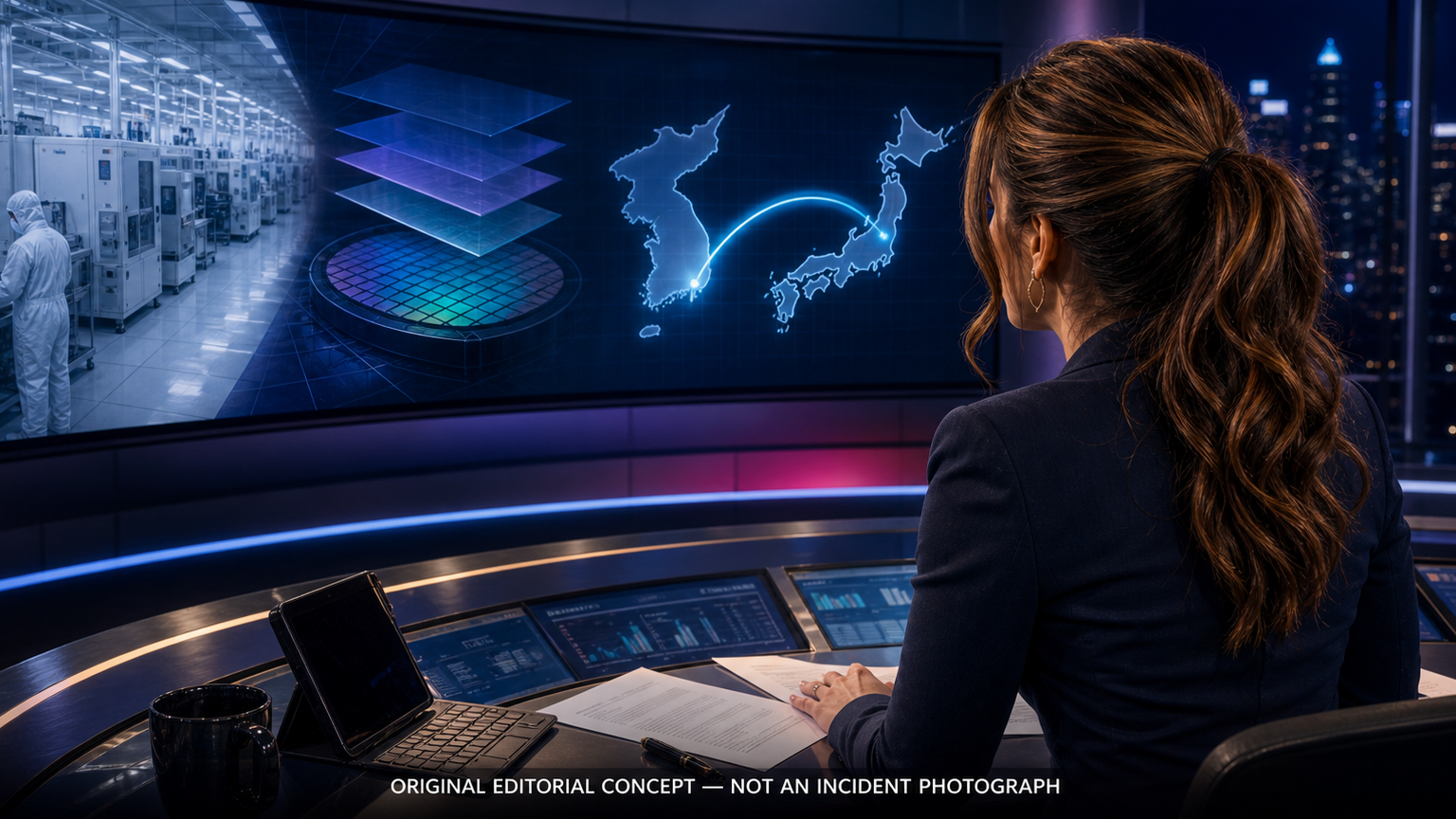
Near-window fallback • Possible location, no final plant decision
SK Hynix says no decision yet on reported Japan memory-chip plant
Status: South Korea’s Hankyoreh newspaper reported that SK Hynix is considering a large memory-chip plant in Japan’s Miyagi prefecture. SK Hynix told Reuters that no decision has been made, while acknowledging that any location with the required infrastructure could be considered.
What happened
Reuters reported shortly before the 9 p.m. Night Shift cutoff that SK Hynix was considering a memory-chip manufacturing investment in Miyagi prefecture in northeastern Japan. The wire service attributed the central claim to Hankyoreh, which cited unnamed industry sources.
Hankyoreh reported that the possible project could involve tens of trillions of South Korean won and would expand production capacity as global demand for memory chips grows. The newspaper also said SK Group Chairman Chey Tae-won recently visited the area, one of Japan’s designated semiconductor industry hubs.
The most important sentence came from the company response. SK Hynix told Reuters: “any location with the necessary infrastructure could be a potential candidate,” but said no decision had been made. That statement keeps the story in the evaluation stage. It does not establish a selected site, approved budget, construction schedule, production technology or final product mix.
If the plan moves forward, Hankyoreh said it would be the first large-scale semiconductor manufacturing investment in Japan by a South Korean chipmaker. That would make the project strategically significant—but the conditional “if” carries real weight. This edition is about a reported possibility and the company’s cautious response, not a factory groundbreaking.
Why it matters
Memory is one of the least glamorous and most important constraints in modern computing. AI accelerators need enormous quantities of fast memory to keep processors fed with model weights and intermediate results. Servers, phones, PCs and industrial systems also depend on DRAM and storage. When memory supply becomes tight, prices and delivery schedules can move across the technology market.
SK Hynix is a major memory producer, especially in high-bandwidth memory used alongside AI accelerators. A large new plant would therefore matter beyond one company or one country. It could add geographic diversity, deepen collaboration with Japanese materials and equipment suppliers, and place production inside a country that has been working to rebuild its semiconductor manufacturing base.
Japan offers mature infrastructure, a deep supplier network and policy interest in semiconductor investment. Miyagi’s designation as an industry hub is relevant because fabs require more than land: they need dependable electricity, vast clean-water systems, transport links, specialist contractors, chemical handling, waste treatment and a trained workforce. SK Hynix’s own statement focused on infrastructure rather than naming a preferred site, which is a useful clue about what the company says it is evaluating.
The cross-border angle is equally important. South Korean and Japanese companies are already linked through memory, materials, equipment and electronics supply chains. A South Korean-owned production site in Japan could make those relationships more durable while spreading some operational risk. It could also introduce new dependencies involving incentives, permitting, labor, utilities and local politics.
None of this means a future fab would quickly fix memory shortages. Semiconductor plants take years to plan, permit, build, equip, qualify and ramp. Even after construction, output depends on yields, customer qualification and the product generation being manufactured. A reported investment can be strategically meaningful without changing the price of a laptop or server this month.
Who is affected
Cloud and AI operators should watch because additional memory capacity may improve long-term supply resilience. The practical benefit would depend on what the plant actually produces—standard DRAM, high-bandwidth memory, NAND or another technology—and when qualified volume becomes available. The current report does not answer those questions.
PC builders, repair shops and business buyers may eventually feel the result through component pricing and availability. They should not adjust purchasing plans from this headline alone. A possible factory is not near-term inventory, and memory prices still respond to current output, demand forecasts and existing capital spending.
Japan and South Korea would face industrial-policy questions about incentives, jobs, technology protection and supply-chain resilience. The report does not identify a subsidy package, local agreement or government approval. Those would be separate milestones to verify.
Miyagi communities could see jobs, construction and supplier activity if a project is selected. They could also face power, water, housing and transport demands. Because no site or project documents are public in the checked evidence, local impacts remain potential rather than established.
Investors and suppliers should distinguish a site review from an approved capital program. The most useful evidence would be a company filing, board-approved expenditure, government incentive agreement, land transaction, construction contract or equipment order.
What readers should do
- Do not treat “considering” as “building.” Wait for a named site, investment approval and schedule before counting future capacity.
- Do not convert “tens of trillions of won” into a precise dollar figure. The source gives a broad range, not a fixed budget or exchange-date calculation.
- For memory purchases, use current evidence. Check live prices, required specifications and supplier lead times. Do not delay a necessary repair because of a factory that may never be approved.
- For enterprise procurement, qualify alternatives now. Maintain compatible part lists, approved secondary suppliers and realistic inventory thresholds. Geographic diversification helps only when your own supply plan can use it.
- Watch the decision chain. Company confirmation, government incentives, land and utility arrangements, permits, tool orders and a construction start would progressively raise confidence.
Upside, cautions and unknowns
Upside: A real project could diversify memory production, strengthen regional semiconductor supply chains and increase long-term capacity for AI and conventional computing.
Caution: A fab of this scale would carry construction, utility, yield, demand-cycle and geopolitical risks. Semiconductor demand is cyclical, while a plant makes multi-year commitments that cannot be reversed cheaply.
Unknown: The checked sources do not establish a final site, approved investment, product type, wafer capacity, process node, construction date, opening date, subsidy, utility agreement or customer commitment.
Confidence: High that Hankyoreh published the report and Reuters obtained a direct SK Hynix response; moderate-to-low that the contemplated project will proceed in the described form because the company says no decision has been made.
Evidence table: report, response and next proof
Keyboard users can focus the table region and use the arrow keys to scroll horizontally.
| Claim surface | Current evidence | Safe reading |
|---|---|---|
| Miyagi is being considered | Hankyoreh report, relayed by Reuters | A reported candidate location—not a selected site |
| Tens of trillions of won | Broad investment scale attributed to unnamed industry sources | No precise budget, currency conversion or approval is established |
| Chairman visited the area | Reported by Hankyoreh | A visit can support due diligence; it is not a construction decision |
| SK Hynix response | Direct statement to Reuters | No decision; any location with necessary infrastructure may be a candidate |
| First large South Korean chip investment in Japan | Conditional characterization in the originating report | Relevant only if a large-scale project actually proceeds |
| Near-term memory supply | No production plan disclosed | No immediate change to component availability or prices |
Frequently asked questions
Has SK Hynix approved a Japanese factory?
No. The company told Reuters that no decision has been made.
Is Miyagi definitely the site?
No. Miyagi is the location named in Hankyoreh’s report. SK Hynix’s response described any location with the needed infrastructure as a potential candidate.
How much would the plant cost?
The report says tens of trillions of won, which is a broad scale rather than a final budget. No approved amount was disclosed.
Would this make RAM or SSDs cheaper?
Not immediately. Any effect would depend on approval, construction, product mix, ramp timing, yields and demand conditions.
Why is this a near-window selection?
Reuters’ original report was published at 00:57 UTC, about 20 minutes before the prior 9 p.m. Night Shift desk cutoff of 01:17 UTC. That places it inside the permitted six-hour fallback window. The core-window candidates that were checked were derivative republications, insufficiently sourced, already covered, or less material.
Sources
- Reuters — “South Korea’s SK Hynix considers building memory chip plant in Japan, Hankyoreh reports”, published August 21, 2026 at 00:57 UTC. The direct page blocked automated retrieval.
- WDEZ — accessible Reuters syndication copy, published at 00:56:56 UTC and modified at 01:56:59 UTC; used to verify the full Reuters text, company quote, attribution and caveats.
- SK Hynix Newsroom, checked for direct company announcements. No matching final plant decision was located during this reporting window.
Reporting cutoff: August 20, 2026 at 11:31 p.m. EDT (August 21 at 03:31 UTC). Near-window fallback used. This is one subject selected from the newest verified global technology developments and checked against The IT Guys’ daytime and prior Night Shift coverage.