

Critical infrastructure alert
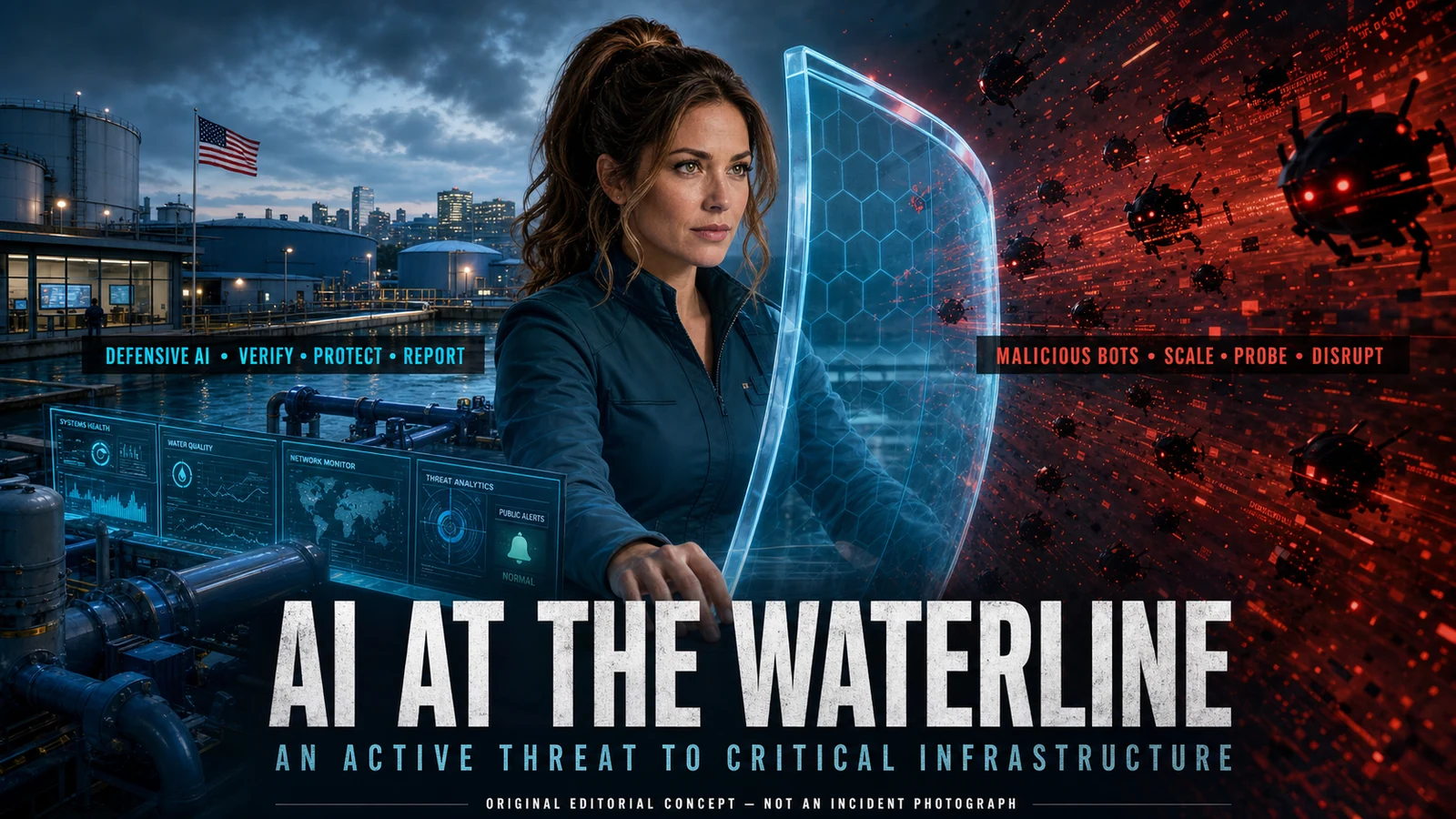
Five U.S. agencies say malicious actors are using artificial-intelligence assistance to build and rapidly refine scripts aimed at industrial controllers that help run water, energy, manufacturing, agriculture, chemical plants, and other essential systems. The agencies call it an active threat—and warn that exposed or poorly segmented controllers can become a path toward disruption, safety incidents, equipment damage, and cascading effects. [1]
What the federal government says is happening
Advisory AA26-231A says threat actors are actively targeting Siemens S7-series programmable logic controllers—small industrial computers that monitor or control physical processes. The actors use AI assistance to generate exploitation scripts from public information, iterate faster, and disguise tools as ordinary monitoring software. Agencies say this can give unauthorized read/write access to controller memory, configuration, and industrial logic. [1]
The agencies assess the current activity pattern is likely persistent reconnaissance and capability development: learning facilities, refining techniques, and positioning for potential future write operations that could cause disruption. That is already a national-security concern because the same controller family appears across water/wastewater, energy, critical manufacturing, chemical, food/agriculture, commercial facilities, and potentially the Defense Industrial Base. [1]
What “AI-assisted” really means
This is not evidence of a self-aware bot independently deciding to attack a water plant. It is evidence that people can use generative systems to compress research, coding, adaptation, and tool-building work that once demanded more specialized industrial-control knowledge. Federal agencies call that an evolution in capability because it lowers technical barriers and speeds adaptation. [1]
That is why responsible AI design matters. A defensive assistant can verify advisories, help inventory assets, summarize evidence, translate technical guidance, draft public notices, and find inconsistencies—while refusing attack execution and leaving operational decisions to authorized humans. A maliciously directed bot can accelerate the opposite side of that same information problem.
Two connected warnings—do not collapse them into one incident
| Evidence window | Controller focus | What is confirmed | What remains bounded |
|---|---|---|---|
| July 30 FBI/EPA + CISA water alerts | Rockwell MicroLogix 1100/1400 observed | Lockouts, IP/password changes, loss of control, pressure loss, flooding, boil-water notices, manual operations | No claim that every incident caused contamination or public-health injury |
| August 19 five-agency AA26-231A | Siemens S7-200/300/400/1200/1500 families | Active AI-assisted targeting, reconnaissance, script development, controller read/write capability, pre-positioning assessment | Potential severe effects are not all confirmed outcomes of this campaign |
| Separate AA26-097A campaign | Multiple PLC vendors | Iranian-affiliated activity, project/HMI/SCADA manipulation, some disruption and financial loss | Do not automatically attribute AA26-231A to the same actor |
Real effects have already crossed from computers into operations
The July FBI/EPA warning says at least seven states reported incidents after July 27 and that some activity degraded water operations. Reported effects included loss of pressure and flooding. The FBI warned that pressure loss could potentially allow untreated groundwater to enter pipes—a mechanism of risk, not a statement that contamination was confirmed. [3]
CISA separately reported password and network-setting changes that locked out operators or disconnected controllers, resulting in boil-water notices and sustained manual operations. CISA warned that exposed OT can face configuration changes, disruption, and in severe cases physical damage. [2]
Later reporting based on federal and state officials described similar activity in at least 12 states and more than 30 Minnesota community water systems. Those officials said the systems continued operating safely with no known public-health effects in that reporting window. [8]
Evidence ladder: what is confirmed, assessed, possible, and unknown
Confirmed
Federal agencies observed AI-assisted script development and targeting of Siemens S7 controllers. Separate water incidents produced lockouts, loss of control, pressure loss, flooding, boil notices, and manual operation.
Assessed
AA26-231A assesses the pattern as persistent reconnaissance and capability development intended to prepare for possible operational effects.
Potential—not automatically observed
Unauthorized industrial control could cause safety incidents, equipment damage, downtime, sensitive-data loss, and cascading effects. These are credible consequences, but the article does not label every one a completed event.
Unknown or unconfirmed
The AA26-231A actor identity, Siemens victim count and locations, exact future intent, AI models or services used, degree of human direction, and whether any Treasure Coast utility is affected are not established by the sources reviewed.
Why the danger is national-security significant
Water is not merely another internet service. Pumps, valves, pressure, treatment, alarms, and safety interlocks connect computer decisions to physical operations. The same PLC ecosystem also supports energy, manufacturing, chemicals, food production, and defense-related facilities. A weak controller can therefore become more than an IT outage: it can force manual operation, interrupt public service, damage equipment, conceal unsafe conditions, or produce cascading dependencies. [1]
A separate federal advisory attributed other recent PLC activity to Iranian-affiliated actors and documented manipulation of project logic and HMI/SCADA displays; agencies said some changes disabled critical shutdown and alarm logic, allowing unsafe conditions without operator warning. That separate campaign shows why capability development cannot be dismissed as harmless scanning. [4]
What water utilities, vendors, and IT providers should do now
Inventory every controller and remote path
Include equipment installed by operators, contractors, vendors, and system integrators—especially cellular modems or remote connections missing from normal IT inventories.
Remove direct internet exposure
Do not leave a PLC reachable from untrusted networks. Broker authorized remote access through monitored, controlled gateways designed for OT.
Patch and harden after testing
Verify supported firmware/software, replace defaults, strengthen credentials, restrict engineering access, and pilot changes before touching production processes.
Separate IT from OT
Validate segmentation, firewall policy, remote-vendor pathways, and whether a corporate compromise can reach physical control systems.
Watch for unauthorized change
Alert on unexpected controller access, configuration or logic changes, off-hours activity, unapproved software, unexplained lockouts, and work without a matching change ticket.
Keep known-clean logic and configuration backups
Verify integrity before restoration. A backup containing malicious logic is not a recovery point.
Practice safe manual operation
Test business continuity, fail-safe behavior, manual controls, standby systems, and communications before an incident forces the transition.
Report and coordinate early
Activate the organization’s incident plan and contact CISA, FBI/IC3, EPA assistance, and relevant vendors. Preserve evidence before cleanup.
“See something, say something”—without exposing the system
Utility employees and operators
Escalate unexpected password/configuration changes, loss of controller visibility, unexplained manual-mode transitions, unfamiliar remote sessions, undocumented modems, or actions with no change ticket through your internal incident process immediately.
Vendors, integrators, and managed IT
Tell the asset owner about exposed remote access, default credentials, unsupported equipment, shared configurations across customers, or monitoring gaps. Do not quietly fix and erase evidence.
Ordinary residents
Verify boil-water notices, outages, pressure alerts, or unusual utility communications through the official city/utility website or phone number. Report service anomalies to the utility; call 911 for immediate threats to life or public safety.
Security researchers
Do not scan, probe, log into, or manipulate water/OT equipment. Privately report accidental exposure to CISA or the organization. Never publish addresses, screenshots, network details, model/serial information, or employee identities.
Official reporting and assistance
- Active organizational cyber incident: CISA’s 24/7 Operations Center is listed in the federal alert at 1-844-SAY-CISA and contact@cisa.dhs.gov. [2]
- Cybercrime report: file through the FBI’s Internet Crime Complaint Center and contact a local FBI field office when directed. [6]
- Water-sector technical help: use the EPA Cybersecurity Technical Assistance Program. [5]
- Immediate physical danger: call 911 and follow local emergency-management/public-health instructions.
How defensive AI should be used
Good defensive uses
Advisory monitoring, asset-inventory reconciliation, log triage, anomaly prioritization, change-ticket comparison, backup verification support, public-language drafting, and cross-source fact checking—with human authorization and review.
Dangerous or unacceptable uses
Generating attack scripts, finding exposed public targets, bypassing controls, modifying industrial logic, concealing activity, automating physical effects, or publishing sensitive infrastructure details.
For The IT Guys, the defensive model is simple: retrieve primary evidence, distinguish confirmed facts from potential harm, refuse operational attack assistance, warn the public without teaching the attack, and route actionable information toward authorized defenders. AI does not replace accountable engineers, operators, incident responders, or public officials.
Local Florida perspective
No source reviewed for this article establishes a compromise affecting Port Saint Lucie, Jensen Beach, Fort Pierce, Vero Beach, or another Treasure Coast utility. Residents should follow official municipal and utility alerts, not assume a cyberattack from an ordinary outage or water-quality concern. Utility and vendor staff should still use this federal warning to verify exposure, remote access, backups, manual operations, and incident contacts now.
What every household can do today
You do not need access to a control room to strengthen community resilience. Start by locating your water utility’s official website, outage page, emergency telephone number, and city or county alert-registration page. Save those contacts before an incident so a social-media screenshot or impersonation message is not your only source during confusion.
- Subscribe to official alerts. Use the utility, municipality, county emergency-management, and public-health channels appropriate to your address.
- Verify urgent notices independently. Navigate to the official site yourself or call a previously saved number. Do not trust a link, QR code, or phone number supplied only inside an unexpected message.
- Maintain reasonable emergency water readiness. Follow FEMA/local guidance for your household, medications, pets, and hurricane plan. Preparedness helps during storms, line breaks, maintenance, and cyber incidents alike.
- Report impersonation and phishing. A fake utility notice asking for credentials, remote access, gift cards, cryptocurrency, or an unusual payment deserves reporting through the utility’s official channel and IC3 when appropriate.
- Do not amplify unverified claims. Share the utility’s original notice rather than adding a cyberattack theory. Rumors can overwhelm call centers and distract operators during a real incident.
Residents can also support local resilience by asking public officials whether water cybersecurity, equipment replacement, contractor access, backup communications, and manual-operation exercises receive adequate resources—without demanding sensitive diagrams or network details in a public meeting.
Frequently asked questions
Did AI autonomously attack U.S. water systems?
The advisory describes human threat actors using AI assistance to generate and iterate exploitation scripts. It does not describe an autonomous AI independently selecting and attacking targets.
Has drinking water been poisoned?
The sources reviewed do not report confirmed poisoning. They report operational effects including pressure loss, flooding, boil-water notices, lockouts, and manual operations. Pressure loss can create a contamination risk, which is why official boil notices must be followed.
Is this only a water-sector problem?
No. The Siemens advisory lists water/wastewater, energy, critical manufacturing, chemical, food/agriculture, commercial facilities, and possible Defense Industrial Base exposure.
Why are PLCs exposed to the internet?
Remote monitoring and maintenance can be convenient, but old designs, contractor-installed modems, limited budgets, undocumented pathways, and weak configurations can create unsafe exposure.
Can I search online for vulnerable water systems?
No. Do not scan, probe, connect to, or publish information about operational technology. Report accidental exposure privately to CISA or the asset owner.
What should I do if I receive a boil-water notice?
Verify it through the official utility/city source and follow the public-health instructions. Do not wait for proof of a cyberattack.
Who should a utility call?
Use the internal incident plan, CISA’s 24/7 Operations Center, FBI/IC3, EPA water-sector assistance, and relevant equipment vendors.
Is this a declared national emergency?
No declaration is identified in the reviewed sources. It is a five-agency active-threat advisory with national-security significance because the targeted technology supports essential physical services.
Sources
- CISA/NSA/FBI/DOE/EPA: AA26-231A—Defending Against an Active Threat to Siemens S7 Series PLCs
- CISA: Water and wastewater PLC targeting alert
- FBI/EPA: I-073026-PSA water-sector operational-disruption warning
- CISA and partners: Iranian-affiliated PLC activity advisory
- EPA water-sector cybersecurity technical assistance
- FBI Internet Crime Complaint Center
- TechCrunch: current AI-assisted water-system threat report
- Nextgov/FCW: multistate water-system incident reporting
Read the five-agency active-threat advisory
Reporting cutoff: August 20, 2026 at 5:57 p.m. EDT / 9:57 p.m. UTC. This public-safety article intentionally omits exploit instructions, network details, and actionable targeting information. It is not legal advice, an incident declaration, or evidence of a local Treasure Coast compromise.